
My work generally focuses on tracking, locating, and decoding speech categories and phonetic features in the human brain. While I work on both speech production and perception, more of my work lives in the realm of perception. I often ask the following broad questions in my research:
- What are the acoustic cues of speech production?
- How do listeners differ in perception of these acoustic cues based on aspects such as language background or identity?
- What is the neurobiology of speech perception?
CV
For links to publications and presentations, please see my CV.
Dissertation
My dissertation specifically addresses the decoding of neural activity associated with laryngeal and pharyngeal speech segments in American English and Modern Standard Arabic. Creaky voice segments such as glottal stops and phrase-final creaky voice are associated with phonemic, allophonic, and prosodic representations in English and Arabic, providing a rich space for studying how the brain decodes similar acoustic features from speech in order to drive comprehension in different languages and across different layers of linguistic representation. To investigate these phenomena, I use magnetoencephalography (MEG) and stereoelectroencephalography (sEEG) in patients with epilepsy.

Other Research
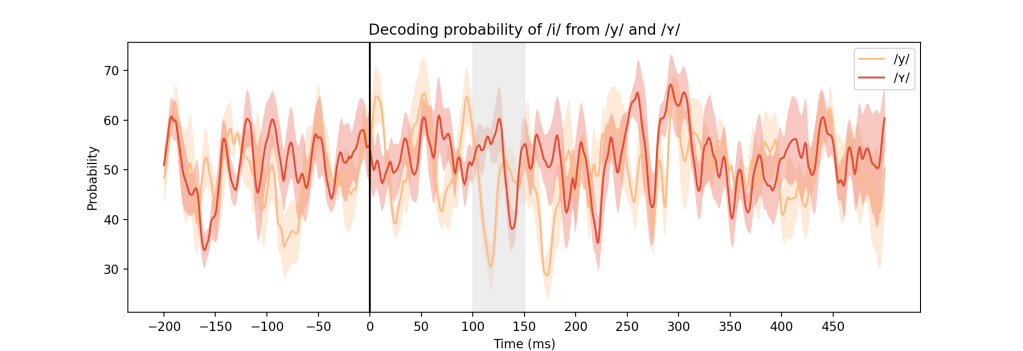
Bilingual Perception of New Sound Segments: This project investigates the neural decoding of novel speech sounds. We ask how the larger language background of bilinguals facilitates or inhibits the perception and decoding of novel speech sounds in comparison to monolingual individuals. Initial results indicate that the specific rates of success for perceiving certain new sounds over others are guided by the listener’s specific language background, reflect the acoustic similarity between the new sounds and known sounds, and condition the neural response to new sounds over time. (Data collection on this project was halted due to the Covid-19 pandemic–stay tuned for more!)
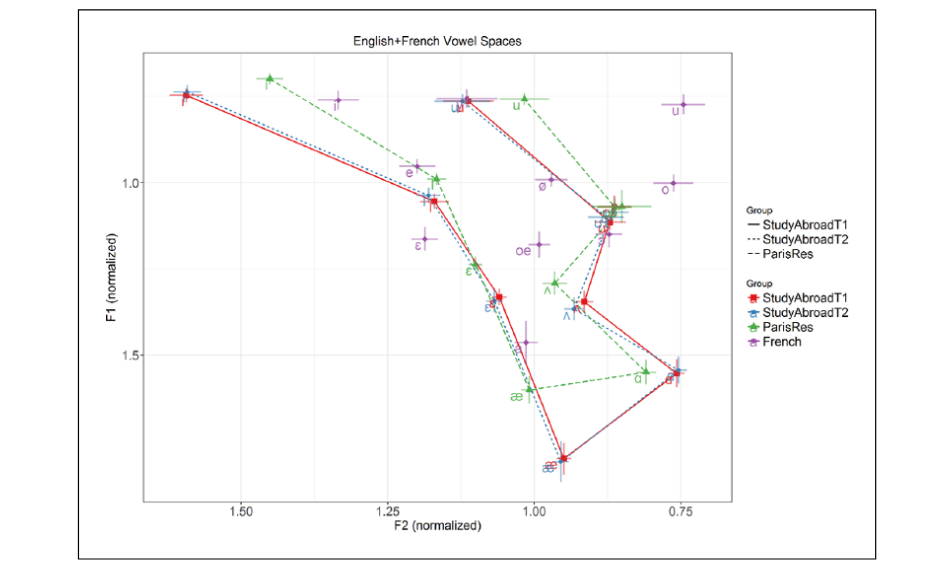
Phonetic Drift: This study looks at the interaction between a speaker’s first language (L1) and second language (L2) vowel spaces during immediate and long-term immersion in the L2 environment. We found that L1 vowel productions shift towards ambient L2 vowel categories due to the length of exposure in the L2 immersion environment.
Pharyngeal Consonants in Modern Standard Arabic: This project examines the extent of laryngeal articulation that contributes to pharyngeal articulation in Modern Standard Arabic using rtMRI sequences of the vocal tract. We find that pharyngeal consonants are not only characterized by pharyngeal constriction, but also additional laryngeal constriction in comparison with laryngeal consonants. This is a small part of an ongoing project collecting rtMRI sequences of the consonant inventory of Modern Standard Arabic.


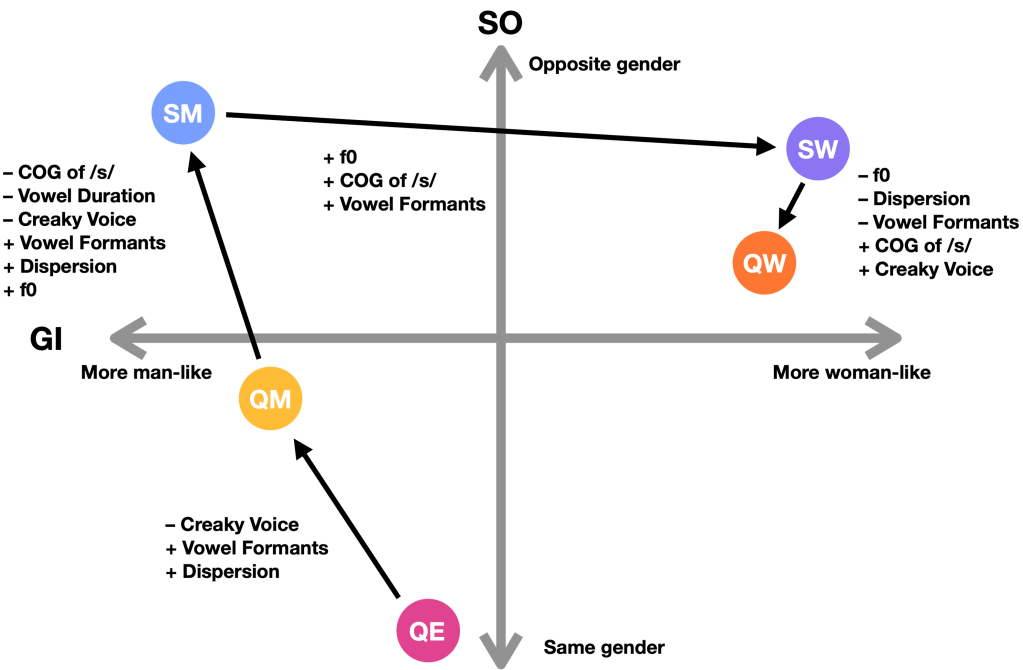
Sociophonetics of Gender and Sexuality: A long-standing question in speech perception and sociolinguistics asks how elements of a speaker’s identity are perceived from the acoustic signal. I assembled a small corpus of excerpts from podcasts and asked how a listener reconstructs a speaker’s gender identity, sexual orientation, and gender expression from speech. I’m interested in the acoustic features that predict listener ratings and perception of a speaker’s gender identity, sexual orientation, and gender expression. A figure showing listener’s perceptual-acoustic space is shown below. The full project can be found here.
 Benjamin Lang